
Corporate news is filtered through managerial decisions about timing, presentation and recognition. Research shows that adverse disclosures can be delayed, surrounded by competing information or released after peers warn. These choices can concentrate the recognition of losses and make a quiet information environment misleading. The pattern of disclosure therefore carries information about governance and downside risk, alongside the facts disclosed.
1. Information presentation tends to be selective
In 49,652 U.S. non-earnings Form 8-K filings from 2005–2018, each accompanied by a same-day press release, 41.8% of negative filings were paired with an unrelated release, compared with 26.2% of non-negative filings. This 15.6 percentage-point gap is descriptive; the association remains after controls. Concurrent unrelated releases were also associated with slower incorporation of negative news into prices and fewer downloads of the filing.[1]
This is evidence that disclosure can be formally available while its presentation impedes recognition. More communication does not necessarily mean that adverse information is easier to assess.
2. How managers shape the news
Delay and obfuscation. Managers have reputational and financial reasons to postpone adverse revelations or make them less salient. Bad-news disclosures elicit larger absolute stock-price reactions than good-news disclosures, consistent with selective withholding.[2] Distraction through unrelated releases can also impede recognition without suppressing the underlying filing.[1]
Packaging and kitchen sinking. Favorable information can accompany a setback to moderate its impact. In biopharma, such packaging is more common with negative product news and attenuates the market reaction.[3] A big bath concentrates losses in an already poor period, potentially making subsequent earnings look stronger. In theoretical models, smoothing and big baths can emerge from the same reporting incentives.[4]
3. Why revelations cluster across firms
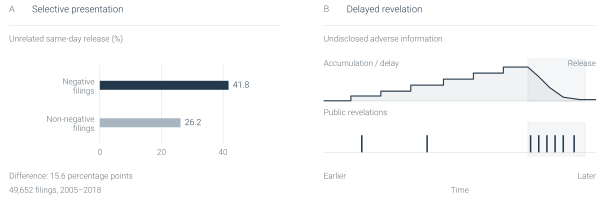
Panel A: Negative filings were more often accompanied by a press release about a different event: 41.8% versus 26.2% for non-negative filings. Sample: filings with same-day releases. Y-CG chart based on [1], Table 2C. Panel B: Adverse information can accumulate during a disclosure delay, then be revealed in a short window. Y-CG conceptual illustration.[2,6,7]
Across 3,016 follower warnings in U.S. industry-quarters during 1996–2003, each additional peer warning in the preceding five days is associated with a 7.4% higher instantaneous rate of warning among firms that have not yet warned. No corresponding clustering appears in good-news alerts. This supports strategic herding, although common information arrivals cannot be ruled out completely.[5]
Clustering can help managers attribute disappointment to industry conditions. A complementary theoretical mechanism operates through disclosure incentives: adverse public news can trigger a wave of announcements even when the arrival of private information is not clustered.[6] Separate managerial timing decisions can therefore concentrate market-wide information risk.
4. How timing becomes financial fragility
The resulting risk is probabilistic and asymmetric: if bad news accumulates, eventual repricing can be abrupt and negatively skewed. In a sample of 40,882 U.S. firm-years (1991–2005), annual crash incidence in the largest size quintile was 22.1% for high-opacity reports versus 16.1% for low-opacity reports—a 6.0 percentage-point gap (Exhibit 2A). Reporting opacity predicts crashes but not large positive jumps (Exhibit 2B); the relationship weakens after Sarbanes–Oxley.[7]
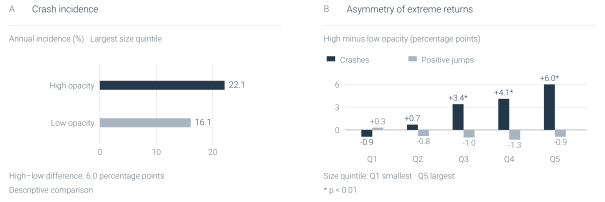
Panel A: High-opacity firms show higher crash incidence in the largest size quintile. Panel B: Crash differences are positive and significant in the three larger quintiles; positive-jump differences are insignificant. Descriptive comparisons; 40,882 firm-years, 1991–2005. * p < 0.01. Source: Y-CG charts based on Hutton, Marcus and Tehranian (2009), Table 8, panels A/C, p. 83.[7]
5. The timing of recognition
Packaging can also supply useful context. In biopharma, other drugs highlighted alongside setbacks were more likely to gain subsequent approvals.[3] The findings identify a recurring asymmetry in disclosure; they do not establish concealment in an individual case.
Delayed revelation separates the timing of economic deterioration from the timing of market recognition. When accumulated information is released in a short window, prices must absorb several setbacks together. The resulting fragility can build during an apparently quiet period.[2,6,7]
References
- [1]Rawson, C., Twedt, B. J., & Watkins, J. C. (2023). Managers’ strategic use of concurrent disclosure: Evidence from 8-K filings and press releases. The Accounting Review, 98(4), 345–371. Tables 2C, 3, 7 and 9.
- [2]Kothari, S. P., Shu, S., & Wysocki, P. D. (2009). Do managers withhold bad news? Journal of Accounting Research, 47(1), 241–276.
- [3]Enache, L., Li, L., Riedl, E. J., & Song, S. (2026). Strategic reporting through counterpoised disclosure: Evidence from the biopharma industry. Contemporary Accounting Research. Advance online publication, September 17.
- [4]Kirschenheiter, M., & Melumad, N. D. (2002). Can “big bath” and earnings smoothing co-exist as equilibrium financial reporting strategies? Journal of Accounting Research, 40(3), 761–796.
- [5]Tse, S., & Tucker, J. W. (2010). Within-industry timing of earnings warnings: Do managers herd? Review of Accounting Studies, 15(4), 879–914. Tables 5 and 7. The 1.074 hazard ratio is conditional on the model and selected industry-quarters with at least three warnings; it is not a 7.4 percentage-point increase or a crash probability.
- [6]Acharya, V. V., DeMarzo, P., & Kremer, I. (2011). Endogenous information flows and the clustering of announcements. American Economic Review, 101(7), 2955–2979.
- [7]Hutton, A. P., Marcus, A. J., & Tehranian, H. (2009). Opaque financial reports, R², and crash risk. Journal of Financial Economics, 94(1), 67–86. Tables 8 (panels A/C), 9 and 11. Opacity uses three years of absolute discretionary accruals. Crashes and jumps are firm-specific weekly returns at least 3.09 standard deviations below or above the fiscal-year mean; financial firms and utilities are excluded.
Important notices
This document has been prepared by Y-CG (“Y-CG Research”) for informational purposes only and is intended exclusively for institutional and professional recipients. It does not constitute, and should not be construed as, investment advice, a recommendation, an offer to sell, or a solicitation of an offer to buy any security, financial instrument, or service, or participation in any trading strategy.
The information contained herein has been obtained from or is based upon sources believed to be reliable, but Y-CG makes no representation or warranty, express or implied, as to its accuracy, completeness, or fitness for any particular purpose. All information, views, and estimates are subject to change without notice. References to research findings, models, indicators, or historical relationships are provided for illustration only; they are not a guarantee of future results, and no representation is made that any objective, projection, or signal will be achieved. Forward-looking analysis is inherently uncertain.
Nothing in this document creates a fiduciary, advisory, or contractual relationship between Y-CG and any recipient. Recipients should make their own independent evaluation of the matters described herein and, where appropriate, seek advice from their own professional advisers. Y-CG is not a registered investment adviser, broker-dealer, or credit rating agency, and nothing herein constitutes regulated investment research, a credit rating, or legal, accounting, or tax advice.
Third-party findings are attributed in the relevant source notes. No endorsement by the cited authors or publishers is implied.
The distribution of this document may be restricted by law or regulation in certain jurisdictions. This document may not be reproduced, redistributed, or disclosed, in whole or in part, without the prior written consent of Y-CG. © 2026 Y-CG. All rights reserved.
Contact: connect@y-cg.com; www.y-cg.com