Y-CG Research
Original governance research for financial services
New analytical capabilities for understanding how incentives, control and strategic decisions affect value and risk.
Reframing financial analysis
Financial outcomes depend on decisions made by those entrusted with capital. Y-CG examines the incentives, authority and information behind those decisions, and the consequences for investors and other principals.
Our original research models, specialized data structures and expert reasoning engine bring these relationships into systematic financial analysis. Advances in research methods and technology make it possible to apply this knowledge across companies, funds and financial institutions.
The research foundations of the Y-CG Expert System
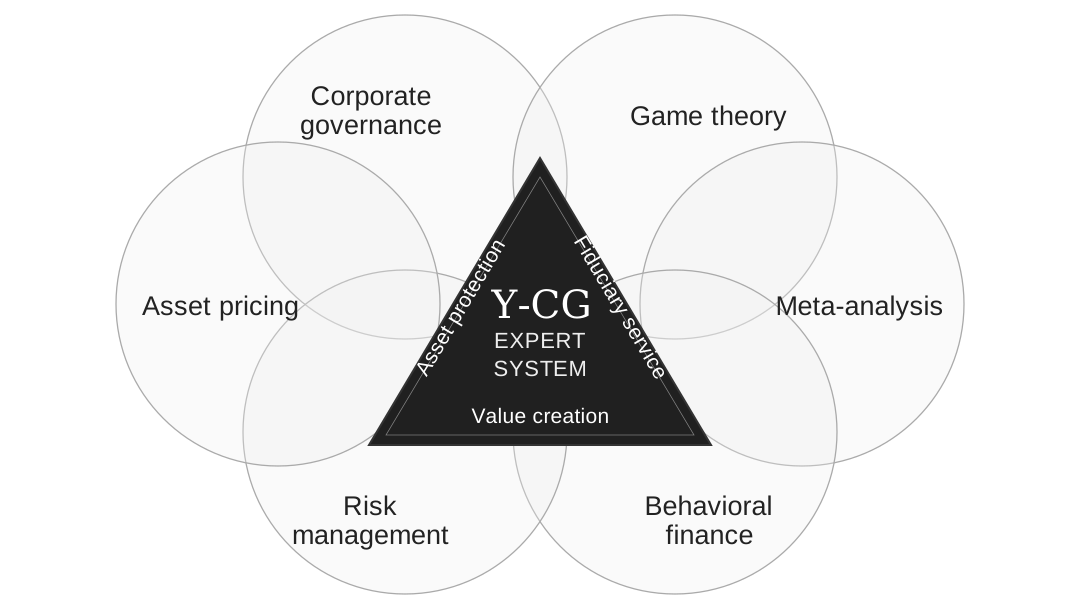
Asset protection
Identify governance conditions that expose capital to avoidable loss.
Fiduciary service
Support informed decisions, oversight and a documented basis for judgment.
Value creation
Apply governance insights to valuation, capital allocation and ownership decisions.
The evidence base
01Research capacity built into an expert system
The Y-CG Expert System organizes academic research, professional standards and financial evidence into a common analytical framework. Its research base spans more than 12,000 papers and studies, mapped across 300-plus governance analytical domains. Meta-analysis connects findings across research designs, markets and institutional settings. It establishes where relationships are supported, how material their effects are, and which conditions affect their application.
This evidence supports company and portfolio analysis through domain-specific models and decision rules. The assessment considers conflicting findings, the quality of available information and the interests of the investor or principal concerned.
- Academic research, professional standards and financial evidence
- 300-plus governance analytical domains
- Meta-analysis of material effects and the conditions behind them
- Assessment of conflicting findings and evidence quality
The analytical framework
02The expert reasoning engine
Y-CG models governance as strategic interaction among decision-makers with different interests, powers and information. Game theory and behavioral finance help explain how those positions influence choices over capital, disclosure, risk and control.
The engine connects observed conditions to the mechanism through which they can affect financial outcomes. A compensation arrangement, financing constraint or control right is examined in the context of the surrounding governance system.
- Game theory applied to incentives, control and constraints
- Behavioral analysis of strategic decisions
- Assessment of governance conditions and financial exposure
- Documented evidence, reasoning and financial implications
From research to decisions
03Predictive, not descriptive
Present governance conditions can reveal the pressures shaping future decisions. Y-CG identifies these conditions, assesses the choices they encourage and traces the exposure to investors before the consequences are fully reflected in reported performance or market prices.
The analysis specifies the conditions under which a risk could develop, the evidence that would strengthen or weaken the assessment, and the decision it informs. Applications include portfolio monitoring, proxy evaluation, investment analysis and engagement.
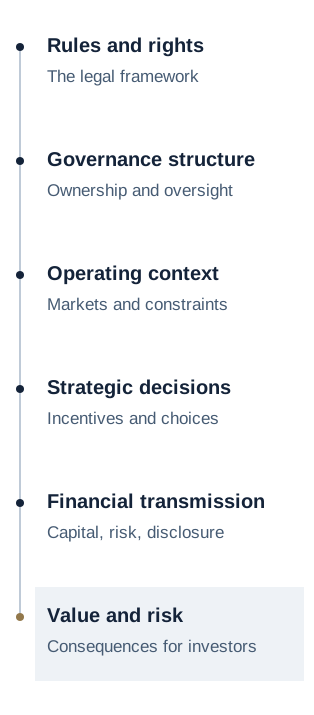
From present conditions to a financial decision
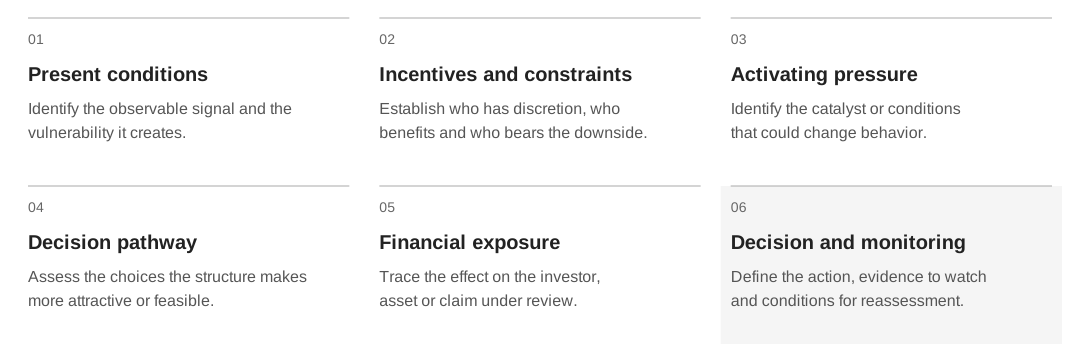
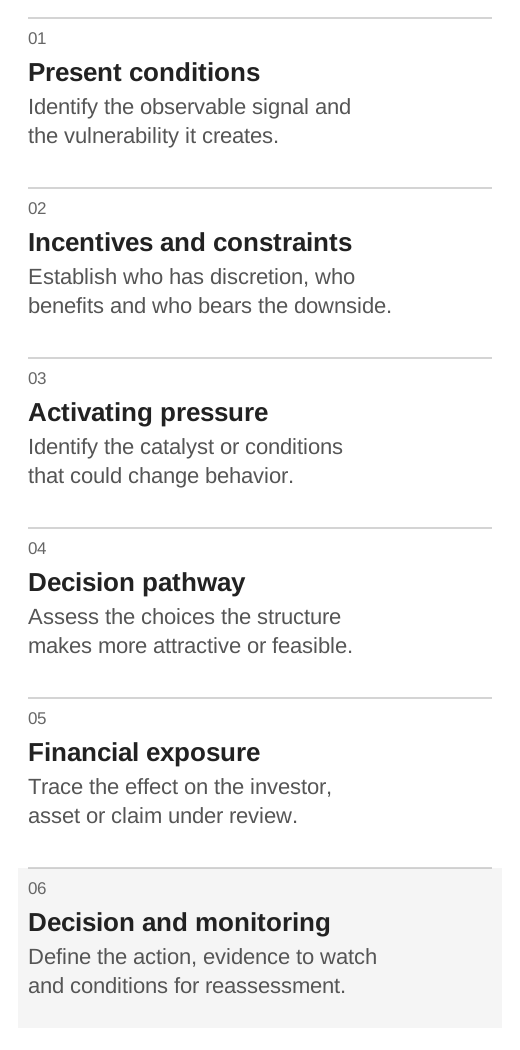
Present conditions
Identify the observable signal and the vulnerability it creates.
Incentives and constraints
Establish who has discretion, who benefits and who bears the downside.
Activating pressure
Identify the catalyst or conditions that could change behavior.
Decision pathway
Assess the choices the structure makes more attractive or feasible.
Financial exposure
Trace the effect on the investor, asset or claim under review.
Decision and monitoring
Define the action, evidence to watch and conditions for reassessment.
Governance establishes the players, their available choices, information, payoffs and timing. Y-CG’s game-theoretical framework uses these conditions to identify the direction in which incentives pull decisions, how other parties may respond, and how those pressures change with financing, control and enforcement.
These incentives can be assessed before a loss occurs or a performance record exists. The analysis therefore applies to new funds, financing structures and mandates, with explicit conditions and observable behavior against which each prediction can be tested.
Original research models
04Original models for financial governance
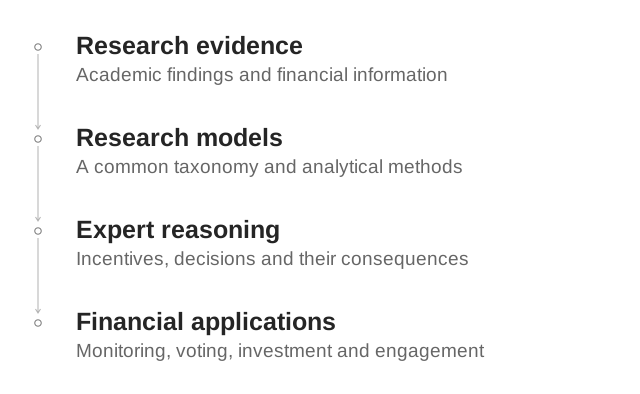
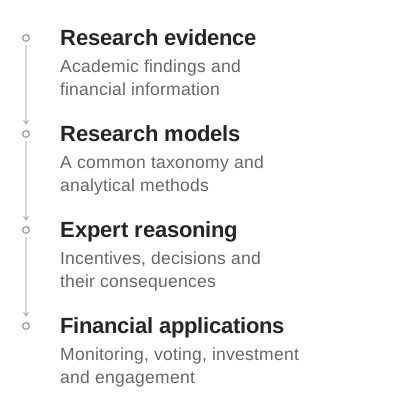
Y-CG’s research models cover the full analytical process, from organizing the knowledge base to assessing financial implications. They share a common taxonomy and evidence base, and operate together within the Expert System.
| Model | Capability |
|---|---|
| 01 · Financial Governance Framework & Taxonomy |
|
| 02 · Evidence Meta-Analysis |
|
| 03 · Asset Pricing with Governance Factor |
|
| 04 · Game-Theoretical & Behavioral Models |
|
| 05 · Risk Models for Corporate Governance |
|
| 06 · Asymmetric Red Flags Model |
|
| 07 · Zero Horizon Models |
|
Research materials
Applied Governance Research in Finance
Y-CG Solutions