
A July 2026 study found that 72% of S&P 500 companies reported adjusted net income or earnings per share. Most reported a higher adjusted figure. The resulting $271 billion gap puts management’s choice of exclusions at the centre of how investors assess performance.[1]
The word “adjusted” has become a routine part of an earnings announcement. That does not make it a small qualification. It signals that management has changed the basis on which performance is being presented, and the difference can be material.
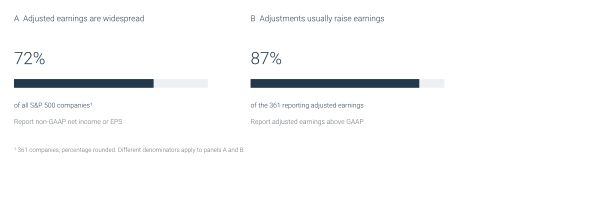
Based on Calcbench and Suffolk University, FY2025 earnings study published July 2026.[1] Percentages rounded; panel B is conditional on reporting adjusted net income or EPS.
A smaller gap remains a substantial gap
The earnings uplift was approximately 23%, compared with roughly 30% in FY2024. The gap narrowed, but adjusted reporting remained commonplace. These findings concern adjusted net income or EPS, rather than the use of every type of non-GAAP measure.[1]
The governance issue begins with the choice of exclusions. A reconciliation makes those choices visible; it does not settle whether they give a faithful account of performance. Investors still have to decide which costs belong in their assessment of the business.
What sits between the two numbers
Oracle’s September 10 release provides a recent example. For the quarter ended August 31, adjusted income available to common shareholders exceeded GAAP income by $1.079 billion. The bridge below shows exactly how.[2]
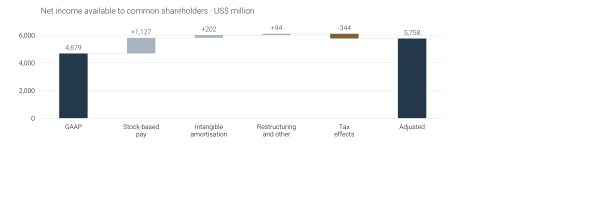
Based on Oracle, Q1 FY2027 reconciliation, p. 2 of the financial tables (PDF p. 6).[2] Tax effects reduce the uplift. Figures are company-reported; inclusion is not an allegation of improper reporting.
Stock-based pay is the largest add-back. It was $1.127 billion, almost unchanged from $1.124 billion a year earlier. Removing a non-cash expense does not remove the economic cost of compensating employees with equity. Amortisation and restructuring raise different questions about acquisition costs and whether supposedly exceptional expenses recur.
The comparison also cuts both ways: Oracle’s adjusted EPS was higher, but grew 30%, versus 55% for GAAP EPS. A higher earnings level does not necessarily mean faster growth.[2]
Non-GAAP measures can clarify operating performance. Their usefulness depends on the exclusions, their consistency over time and the economic question being asked. Once adjusted earnings become routine, scrutiny of the adjustments should become routine too.
References
[1] Calcbench. (2026, July 7). Special report: Non-GAAP adjustments in 2025. Study conducted with Suffolk University.
[2] Oracle Corporation. (2026, September 10). Q1 fiscal 2027 financial results. Reconciliation of selected GAAP measures to non-GAAP measures.
Important notices
This document has been prepared by Y-CG (“Y-CG Research”) for informational purposes only and is intended exclusively for institutional and professional recipients. It does not constitute, and should not be construed as, investment advice, a recommendation, an offer to sell, or a solicitation of an offer to buy any security, financial instrument, or service, or participation in any trading strategy.
The information contained herein has been obtained from or is based upon sources believed to be reliable, but Y-CG makes no representation or warranty, express or implied, as to its accuracy, completeness, or fitness for any particular purpose. All information, views, and estimates are subject to change without notice. References to research findings, models, indicators, or historical relationships are provided for illustration only; they are not a guarantee of future results, and no representation is made that any objective, projection, or signal will be achieved. Forward-looking analysis is inherently uncertain.
Nothing in this document creates a fiduciary, advisory, or contractual relationship between Y-CG and any recipient. Recipients should make their own independent evaluation of the matters described herein and, where appropriate, seek advice from their own professional advisers. Y-CG is not a registered investment adviser, broker-dealer, or credit rating agency, and nothing herein constitutes regulated investment research, a credit rating, or legal, accounting, or tax advice.
Third-party findings are attributed in the relevant source notes. No endorsement by the cited authors or publishers is implied.
The distribution of this document may be restricted by law or regulation in certain jurisdictions. This document may not be reproduced, redistributed, or disclosed, in whole or in part, without the prior written consent of Y-CG. © 2026 Y-CG. All rights reserved. Contact: connect@y-cg.com; www.y-cg.com