
Financial outcomes reflect decisions made within systems of delegated authority, information and incentives. A meta-level framework makes those relationships explicit. Its practical purpose is to translate real-world situations into testable hypotheses, connect them to relevant evidence and assess the outcomes most likely under the observed conditions. This briefing presents the conceptual foundations and the Y-CG research framework that organises their application.
1. The decision architecture
A financial result is visible; the decision system that produced it often is not. A loan loss, acquisition premium or delayed disclosure can reflect choices shaped by authority, incentives and constraints. Delegation creates scope for decision makers’ interests to diverge from those of capital providers.[1] Markets, technology and chance also matter. The governance question is which features of the decision system altered the feasible choices and their consequences.
Meta-governance moves the analysis upstream: who sets the rules, who can change them, and how those rules shape decisions over capital. Institutional conditions and governance arrangements occupy distinct analytical levels.[2] Their interaction matters for incentives, accountability and enforcement in both financial and non-financial companies.[3]
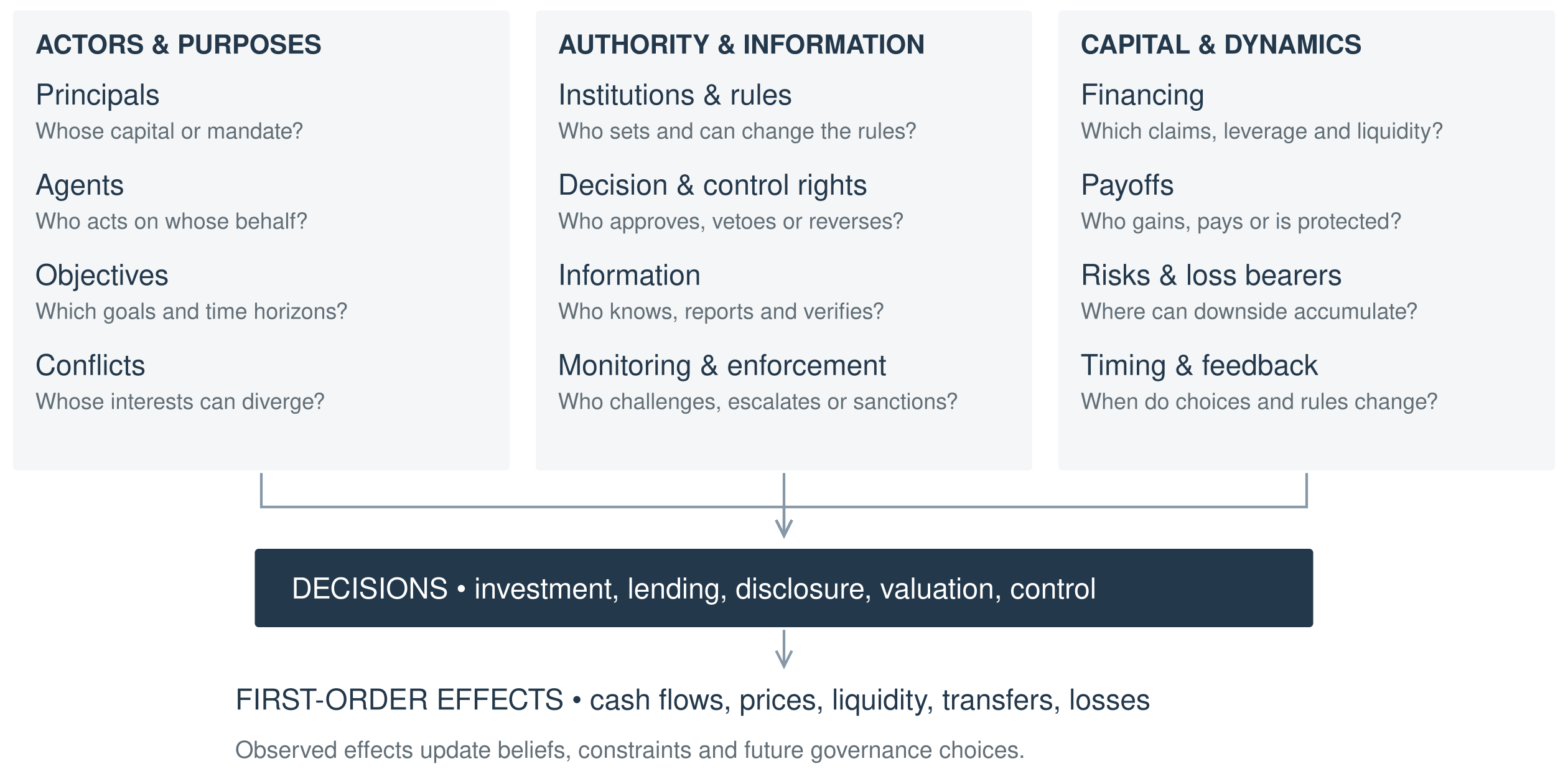
Based on the Y-CG research framework, §8.2.[5] Conceptual synthesis. The component view precedes the formal ontology in Exhibit 2; its numbering does not replace that ontology’s layer definitions.
2. The Y-CG conceptual framework
A shared vocabulary makes knowledge easier to organise, compare and reuse.[4] The Y-CG research framework applies this principle to corporate governance: its conceptual map separates the subject, institutional context, governance factor, mechanism and effect. The map is Y-CG’s synthesis; the underlying agency and institutional foundations draw on established research.[1,2,5]
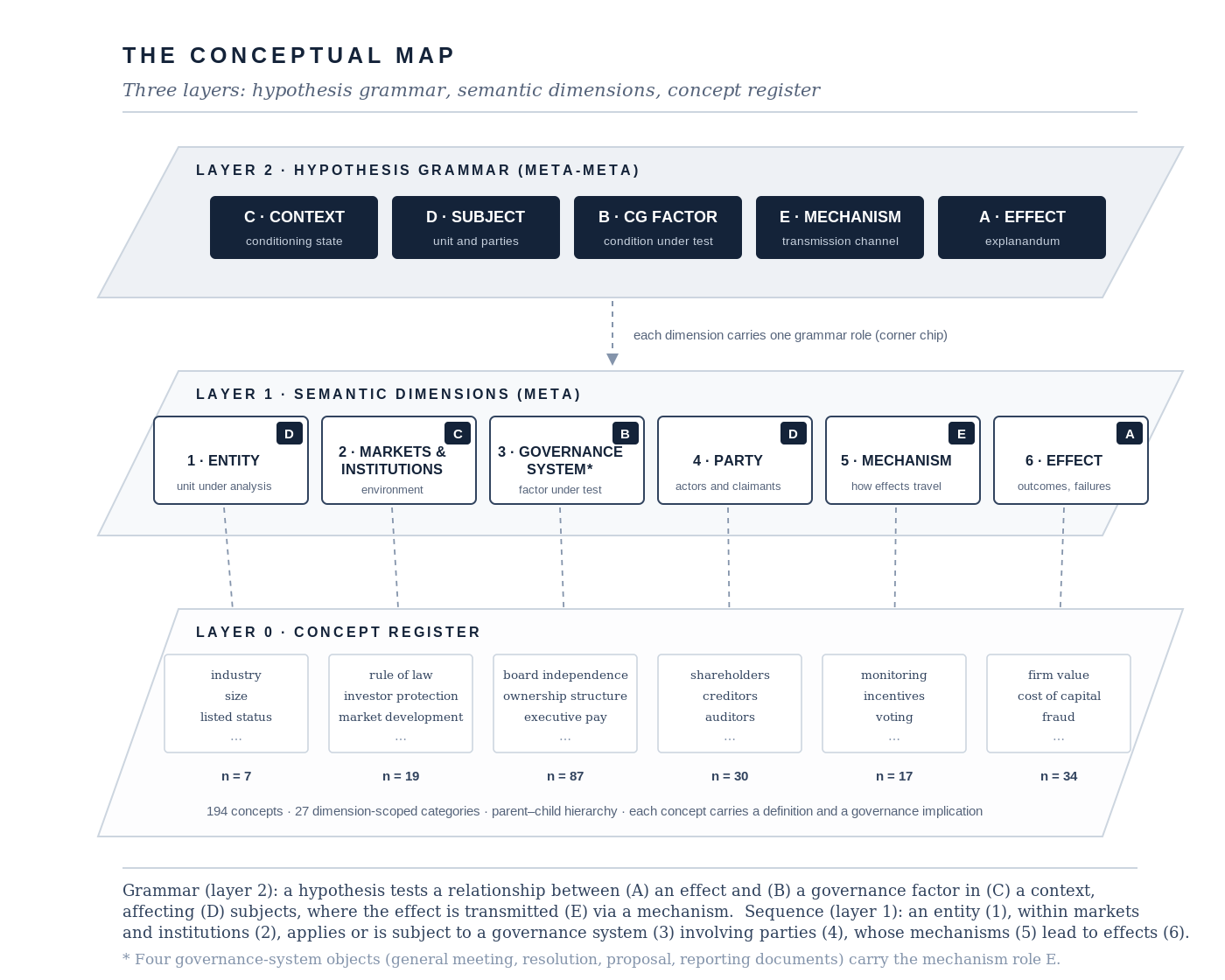
Based on the Y-CG research framework, Figure 23 and §8.1.[5] The map distinguishes the research proposition, semantic dimensions and underlying concepts. Register counts shown in the original figure describe the documented version.
The practical purpose is a blueprint for structuring the analysis of real-world situations. A case is expressed as a testable hypothesis: a specified governance condition, affecting identified parties in a defined context, changes behaviour through a proposed mechanism and produces an observable outcome. The map makes each part explicit, allowing case evidence and relevant research to be matched to the same proposition.[5]
This structure supports rigorous testing: what should be observed if the hypothesis is correct, which alternative explanation fits the facts, and what would contradict it? Where the evidence permits, competing hypotheses can inform an assessment of the most likely outcome, its timing and the claimant exposed. The assessment remains conditional and is updated as new observations arrive.
3. Governance domains and their core conflicts
Sixteen source domains identify where governance findings originate. The groups below organise them by the economic relationship at issue; the original domain numbers are retained. Six analytical overlays interpret source-anchored evidence and cannot originate findings alone.[5]
Table 1. Governance domains and core conflicts
| No. | Domain | Core governance conflict |
|---|---|---|
| A. Authority, oversight and incentives | ||
| 1 | Ownership, Control & Minority Protection | Controllers’ private benefits vs cash-flow claimants and minority protection. |
| 2 | Board Architecture & Oversight | Independent challenge vs managerial influence and capture. |
| 3 | Executive Incentives & Managerial Power | Incentive alignment vs rent extraction; long horizons vs target gaming. |
| B. Information, assurance and risk controls | ||
| 4 | Disclosure & Information Integrity | Informed insiders vs outside claimants under asymmetric information. |
| 5 | Audit, Gatekeepers & Assurance | Credible monitoring vs fee dependence and capture. |
| 6 | Risk Appetite & Internal Controls, Resilience | Agents’ upside capture vs dispersed downside; control cost vs tail risk. |
| C. Capital allocation and claimant rights | ||
| 7 | Treasury, Financing, Tax & Balance Sheet | Shareholder–manager incentives vs creditor protection. |
| 8 | Transactions, Capital Actions & Restructurings | Process fairness and claimant allocation vs entrenchment and value transfer. |
| 10 | Strategy & Capital Allocation Governance | Long-term value vs empire building and self-preserving deployment. |
| 16 | Creditor Governance & Claim Priority | Equity discretion in good states vs creditor control in bad states. |
| D. Organisational boundaries and institutions | ||
| 9 | Corporate Structure, Jurisdiction & Opacity | Transparency and enforceability vs hidden control and liability segregation. |
| 12 | Legal, Regulatory, Political & State Nexus | Formal rules and enforcement vs access, discretion and privilege. |
| 14 | Third-Party Dependency & Boundary Governance | Control of critical activities vs partly aligned external parties. |
| E. Conduct and external effects | ||
| 11 | Competition & Market Conduct Integrity | Rent defence and opportunism vs lawful competition and franchise value. |
| 13 | People, Culture & Organizational Conduct | Norm enforcement vs rule-bending, retaliation and tolerated misconduct. |
| 15 | Sustainability, Externalities & Transition | Private value capture vs unpriced external costs; commitment vs change. |
| F. Analytical overlays — interpretation only | ||
| 17 | Strategic Mediation (Game-Theoretic) | How conflicts originating in source domains are strategically played. |
| 18 | Behavioral Pathologies | Formal structures vs judgment distortions operating within them. |
| 19 | Macro & Systemic Context | Exogenous regime conditions vs endogenous governance quality. |
| 20 | Industry Structure & Sector Context | Sector economics and norms vs firm-specific governance quality. |
| 21 | Market-Based Validation | Market signals as corroboration vs underlying mechanism claims. |
| 22 | Owner Stewardship & Engagement | Owner voice and monitoring vs passivity and rational apathy. |
Based on the Y-CG research framework, Figure 24 and Table 4.[5] Conflicts are condensed from Table 4; lettered groups organise the presentation.
The domain identifies where to look; the hypothesis specifies what to test. Classification becomes useful when it connects a concrete decision to a mechanism, an exposed claimant and evidence capable of supporting or challenging the expected outcome.
4. Testing real-world situations
A real-world case enters the framework as a set of dated observations. These establish the decision, parties, authority, information and payoffs. The analysis then states an expected outcome, the mechanism linking it to those conditions, and the observations that could challenge the explanation.[5]
For a fund, the hypothesis might be: where commercial staff control price overrides and fees depend on reported assets, weak independent challenge increases the likelihood of delayed loss recognition. Tests include override frequency, valuation reversals and the timing of independent challenges. Redemption terms identify which investors may bear the loss. These are illustrative tests, not findings about a particular fund.
For a listed company, the same structure can test whether acquisition incentives and restricted board information favour expansion over value creation. Approval records, financing constraints and subsequent outcomes can strengthen or weaken that explanation. Evidence helps distinguish plausible outcomes; a conceptual fit alone does not establish their probability.
The framework’s contribution is therefore a disciplined connection between a situation, a testable hypothesis and the evidence relevant to its likely consequences. It makes assumptions visible and the assessment open to revision.
Application at Y-CG
Y-CG applies this framework within its Expert System to organise observations, connect research evidence to case hypotheses, and support expert review. The system structures the reasoning and records uncertainty so assessments can be examined and updated.[5]
References
[1] Jensen, M. C., & Meckling, W. H. (1976). Theory of the firm: Managerial behavior, agency costs and ownership structure. Journal of Financial Economics, 3(4), 305–360.
[2] Williamson, O. E. (2000). The new institutional economics: Taking stock, looking ahead. Journal of Economic Literature, 38(3), 595–613.
[3] OECD. (2023). G20/OECD Principles of Corporate Governance 2023. OECD Publishing.
[4] Gruber, T. R. (1993). A translation approach to portable ontology specifications. Knowledge Acquisition, 5(2), 199–220.
[5] Kysucky, V. (2026). Applied Governance Research in Finance: Architecture of Financial Decisions. Y-CG Research white paper, July version (YCGWP 204.1), §§8.1–8.3, Figures 23–24 and Table 4.
Important notices
This document has been prepared by Y-CG (“Y-CG Research”) for informational purposes only and is intended exclusively for institutional and professional recipients. It does not constitute, and should not be construed as, investment advice, a recommendation, an offer to sell, or a solicitation of an offer to buy any security, financial instrument, or service, or participation in any trading strategy.
The information contained herein has been obtained from or is based upon sources believed to be reliable, but Y-CG makes no representation or warranty, express or implied, as to its accuracy, completeness, or fitness for any particular purpose. All information, views, and estimates are subject to change without notice. References to research findings, models, indicators, or historical relationships are provided for illustration only; they are not a guarantee of future results, and no representation is made that any objective, projection, or signal will be achieved. Forward-looking analysis is inherently uncertain.
Nothing in this document creates a fiduciary, advisory, or contractual relationship between Y-CG and any recipient. Recipients should make their own independent evaluation of the matters described herein and, where appropriate, seek advice from their own professional advisers. Y-CG is not a registered investment adviser, broker-dealer, or credit rating agency, and nothing herein constitutes regulated investment research, a credit rating, or legal, accounting, or tax advice.
Third-party findings are attributed in the relevant source notes. No endorsement by the cited authors or publishers is implied.
The distribution of this document may be restricted by law or regulation in certain jurisdictions. This document may not be reproduced, redistributed, or disclosed, in whole or in part, without the prior written consent of Y-CG. © 2026 Y-CG. All rights reserved.
Contact: connect@y-cg.com; www.y-cg.com