
Financial intermediaries undertake monitoring that dispersed investors would find costly to perform individually. In the delegated-monitoring model, this service provides an economic reason for the institution to exist. Its value depends on both the quality of monitoring and the arrangements that discipline the monitor. The governance interpretation is direct: assessing information, constraining discretion and enforcing claims are productive financial activities. Weaknesses in these activities can remain difficult to observe while exposing clients and investors to losses that are unevenly distributed. Governance therefore belongs within the operating model of intermediation and within the analysis of the assets it finances.
1. Why a financial intermediary exists
Why pay an institution to stand between savers and borrowers? Capital can, in principle, pass directly from one to the other. The difficulty is establishing what the borrower does with it, whether reported outcomes are reliable and whether contractual promises will be honoured. Someone must incur the cost of finding out. This briefing builds on the delegated-monitoring model of Douglas Diamond, co-recipient of the 2022 Nobel Memorial Prize in Economic Sciences, to show how governance is the actual core operating model in financial services.[1,7]
Delegated monitoring provides a precise answer. Dispersed lenders can duplicate costly verification or rely on others to do it. An intermediary undertakes the task on their behalf, subject to the cost of making its own conduct credible. Monitoring is consequently part of the service for which the intermediary is paid.[1]
For simplicity, we use “lender” and “borrower” for the provider and user of finance. The delegation problem also arises in equity investment and asset management. These broader applications concern the same need for credible information and oversight; Diamond’s formal result retains its specific lending and debt-contract assumptions.[1,2]
In this briefing, we show the governance implication of that result. Much of what a financial intermediary produces consists of informed judgment over entrusted capital and the ability to act on that judgment. Payment services, liquidity provision and other financial services also explain intermediation. Delegated monitoring is the underlying function of these intermediation services.[2]
2. The economics of delegated monitoring
Financial intermediation arises due to the central comparison between the total cost of delegation and the best available alternative. In the formulation of Diamond’s model, delegated monitoring is worthwhile when:[2]
K is the cost of monitoring one borrower; m is the number of lenders financing that borrower; D is the additional delegation cost per borrower; and S is the contracting cost incurred without monitoring. Direct verification costs mK. Delegation costs K + D. The intermediary must be no more costly than either alternative.[2]
In practice, this means a bank can check a borrower’s accounts and enforce a covenant on behalf of many investors. Doing that work once must save enough to cover both the checks and the cost of making the bank itself reliable. The combined cost must compare favourably with repeating the checks investor by investor or contracting without them.
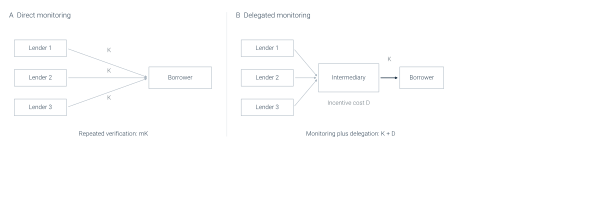
Panel A: Direct verification repeats monitoring across lenders. Panel B: An intermediary monitors for them, while its own incentives add delegation cost D. Y-CG schematic of the cost comparison in Diamond (1996), pp. 53–54.[2]
Diversification is essential to the original model’s solution. Pooling sufficiently independent borrower outcomes allows the intermediary to make its own repayment more dependable and reduce expected delegation costs. The result depends on the portfolio and contractual assumptions; simply increasing the number of loans does not eliminate common exposures.[1]
The governance implication lies in D. Transferring authority does not remove the need for accountability. It changes where accountability must operate. An institution can economise on borrower monitoring only if investors can also rely on the institution’s reporting, incentives and exercise of authority. Assessing the intermediary therefore includes assessing the system through which its monitoring is performed.
3. What the intermediary is monitoring
Monitoring concerns the relationship between economic performance and the decisions that produce it. A debt-service ratio describes capacity to pay. Assessing the reliability of that capacity also requires examining who controls cash, whether assets can be transferred elsewhere and whether the lender can obtain information and intervene. These are governance questions.
Screening assesses an opportunity before capital is committed: whether to finance it, on what terms and with which protections. Monitoring follows the commitment, checking information and conduct and supporting intervention when needed. They are complementary activities, but theoretically distinct. Diamond’s model centres on information revealed after investment; models of project evaluation address selection before investment. Here, screening is included descriptively as the first stage of the intermediary’s information and governance work.[1,8]
In the formal model, monitoring reveals borrower information that outside lenders cannot observe without cost. Its interpretation as governance research is broader: examine the incentives, information rights and constraints that make a claim dependable. Financial analysis remains necessary; governance analysis asks whether the conditions underlying that analysis can be altered by those exercising discretion.[1]
| Service | Entrusted function | What requires monitoring |
|---|---|---|
| Bank lending | Screen borrowers and oversee repayment | Use of proceeds, related-party transfers, covenant compliance and intervention rights |
| Asset management | Exercise investment discretion for clients | Mandate adherence, valuation, transaction allocation, execution and conflicts |
| Pension trusteeship | Represent beneficiaries and oversee delegates | Manager incentives, information access, investment limits and replacement rights |
| Custody | Safeguard assets and administer transfers | Asset segregation, authorised instructions, reconciliations and subcustodian oversight |
Y-CG functional mapping. The examples extend the governance interpretation beyond the lending model; the applicable duties depend on the mandate and legal setting.
Fiduciary responsibility gives this operating role a specific purpose where such a duty applies: discretion must be exercised for the entrusted interest. Agency representation translates that purpose into decisions about information, permissions, conflicts and recourse. The relevant standard is whether the institution can carry out the function entrusted to it.
This makes the perspective of the analysis consequential. A policy that increases returns to the intermediary’s shareholders can impose costs on clients or creditors. Effective shareholder oversight alone does not settle whether delegated authority is being exercised appropriately for those parties. Governance quality must be evaluated against the claim and objective being protected.[5]
4. The monitor must also be governed
Investors may be able to observe a loan’s eventual outcome without observing the effort spent monitoring it. This creates room for an intermediary to save costs, favour a commercial relationship or postpone a difficult intervention. A favourable outcome can reflect good monitoring, a benign environment or chance. The result alone cannot identify which explanation is correct.
In U.S. syndicated loans during 1992–2003, lead arrangers retained larger stakes when borrowers disclosed less public information. Panel A shows the unadjusted averages: 38.3% for private borrowers, 35.3% for unrated borrowers and 19.6% for transparent borrowers. Panel B shows the differences after controlling for firm size, loan characteristics, year and industry: private and unrated borrowers were associated with lead shares 2.94 and 2.14 percentage points above transparent borrowers. The evidence is consistent with incentives for delegated monitoring, rather than a causal estimate of monitoring quality.[3]
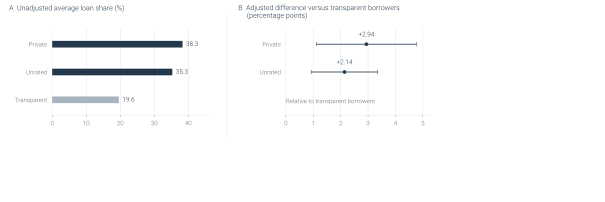
A: Unadjusted average loan share retained by each lead arranger. B: Regression-adjusted differences from transparent borrowers; 4,414 deals. Lines show approximate 95% confidence intervals calculated as coefficient ± 1.96 × reported clustered standard error. Private: no SEC filings. Unrated: filings, no S&P senior unsecured rating. Transparent: both. Source: Y-CG charts using Sufi (2007), Table III, p. 644 (A), and Table IV, column 6, p. 647 (B).[3]
The retained stake is one way of linking monitoring effort to consequences. Operational arrangements address other parts of the problem: who supplies risk information, who can challenge a valuation, whether a breach reaches an independent decision maker and who can replace a delegate. Authority without usable information or credible intervention rights may leave the monitoring function nominal.
A complementary model shows why an economically sound project can still be unable to raise finance when its owner benefits from actions that reduce the chance of repayment. Monitoring restricts those actions. The owner can then be induced to act diligently while retaining a smaller share of the project’s successful payoff, leaving more income available to outside investors. In practice, credible monitoring can make a previously unfinanceable project financeable.[4]
That capacity is limited by the intermediary too. Monitoring effort is costly and hard for outsiders to verify; the monitor must receive enough of the project’s payoff to make diligent monitoring worthwhile and contribute its own capital. A shortage of intermediary capital can therefore constrain lending even when prospective borrowers have worthwhile projects. Governance affects both the reliability of finance and how much finance can be supplied.[4]
5. Why weak monitoring creates asymmetric exposure
Weak monitoring can remain difficult to detect while contractual payments continue. For example, a borrower could add leverage or transfer collateral without immediately missing interest payments. An investor may then observe a stable payment history even though the protection behind the claim has deteriorated. Monitoring examines the change in exposure before the payment record reveals its consequences.
The incentives can be asymmetric as well. With one class of debt, face value F and terminal asset value V, equity receives max(V − F, 0), while creditors receive min(V, F). At fixed promised repayment, a mean-preserving increase in asset risk can transfer value from creditors to shareholders when it creates default exposure. Monitoring and contractual restrictions help constrain that possibility.[5,6]
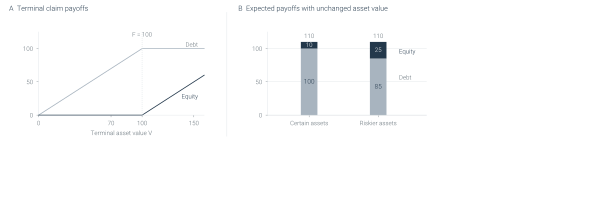
Y-CG numerical illustration of terminal claim payoffs, with debt face value F = 100. Assets are either certain at 110 or equally likely to be 70 and 150. Expected asset value remains 110; expected equity rises from 10 to 25 and expected debt falls from 100 to 85. Undiscounted payoffs; fixed debt terms, limited liability and no bankruptcy costs.[5,6]
This payoff example is a separate extension to the monitoring model. It illustrates a conflict that monitoring may need to govern; it does not imply that every intermediary seeks more risk. Reputation, personal exposure and future earnings can restrain that incentive. Nor does every control failure generate a crash. The exposure is conditional on the decisions permitted, the claims outstanding and the states in which losses emerge.
For financial services, monitoring is a core operating activity and, in Diamond’s model, the economic reason for intermediation. That logic follows capital through the financial value chain. An investor depends on the governance of the asset, the intermediary assessing it and the delegates exercising authority along the way. The financial promise is only as dependable as the arrangements that make it observable, enforceable and worth honoring.
These foundational models show that screening and monitoring is both the key reason for existence of financial services firms and their core operating model. Moreover, the quality of governance translating to better screening and monitoring, better financial outcomes both for investors and the firms.
References
- [1]Diamond, D. W. (1984). Financial intermediation and delegated monitoring. The Review of Economic Studies, 51(3), 393–414. doi:10.2307/2297430.
- [2]Diamond, D. W. (1996). Financial intermediation as delegated monitoring: A simple example. Federal Reserve Bank of Richmond Economic Quarterly, 82(3), 51–66. Cost comparison: pp. 53–54.
- [3]Sufi, A. (2007). Information asymmetry and financing arrangements: Evidence from syndicated loans. The Journal of Finance, 62(2), 629–668. Tables III and IV. doi:10.1111/j.1540-6261.2007.01219.x.
- [4]Holmström, B., & Tirole, J. (1997). Financial intermediation, loanable funds, and the real sector. The Quarterly Journal of Economics, 112(3), 663–691. doi:10.1162/003355397555316.
- [5]Jensen, M. C., & Meckling, W. H. (1976). Theory of the firm: Managerial behavior, agency costs and ownership structure. Journal of Financial Economics, 3(4), 305–360. doi:10.1016/0304-405X(76)90026-X.
- [6]Merton, R. C. (1974). On the pricing of corporate debt: The risk structure of interest rates. The Journal of Finance, 29(2), 449–470. doi:10.1111/j.1540-6261.1974.tb03058.x.
- [7]Sveriges Riksbank. (2022, October 10). Ben S. Bernanke, Douglas W. Diamond and Philip H. Dybvig awarded the Prize in Economic Sciences for 2022. Official award announcement.
- [8]Boyd, J. H., & Prescott, E. C. (1986). Financial intermediary-coalitions. Journal of Economic Theory, 38(2), 211–232. doi:10.1016/0022-0531(86)90115-8.
Important notices
This document has been prepared by Y-CG (“Y-CG Research”) for informational purposes only and is intended exclusively for institutional and professional recipients. It does not constitute, and should not be construed as, investment advice, a recommendation, an offer to sell, or a solicitation of an offer to buy any security, financial instrument, or service, or participation in any trading strategy.
The information contained herein has been obtained from or is based upon sources believed to be reliable, but Y-CG makes no representation or warranty, express or implied, as to its accuracy, completeness, or fitness for any particular purpose. All information, views, and estimates are subject to change without notice. References to research findings, models, indicators, or historical relationships are provided for illustration only; they are not a guarantee of future results, and no representation is made that any objective, projection, or signal will be achieved. Forward-looking analysis is inherently uncertain.
Nothing in this document creates a fiduciary, advisory, or contractual relationship between Y-CG and any recipient. Recipients should make their own independent evaluation of the matters described herein and, where appropriate, seek advice from their own professional advisers. Y-CG is not a registered investment adviser, broker-dealer, or credit rating agency, and nothing herein constitutes regulated investment research, a credit rating, or legal, accounting, or tax advice.
Third-party findings are attributed in the relevant source notes. No endorsement by the cited authors or publishers is implied.
The distribution of this document may be restricted by law or regulation in certain jurisdictions. This document may not be reproduced, redistributed, or disclosed, in whole or in part, without the prior written consent of Y-CG. © 2026 Y-CG. All rights reserved.
Contact: connect@y-cg.com; www.y-cg.com